2025
Biotech platform transforming drug discovery by delivering precise de novo antibodies for undruggable diseases and accelerating the path from target design to functional drug leads within months.
Antiverse
AI-driven drug-discovery platform integrating wet lab to create lab-in-the-loop system for simultaneous design, validation, and functional characterisation of antibodies for undruggable GPCR targets at scale.
Milestones
Series A investment – lead investor, 2025
Team
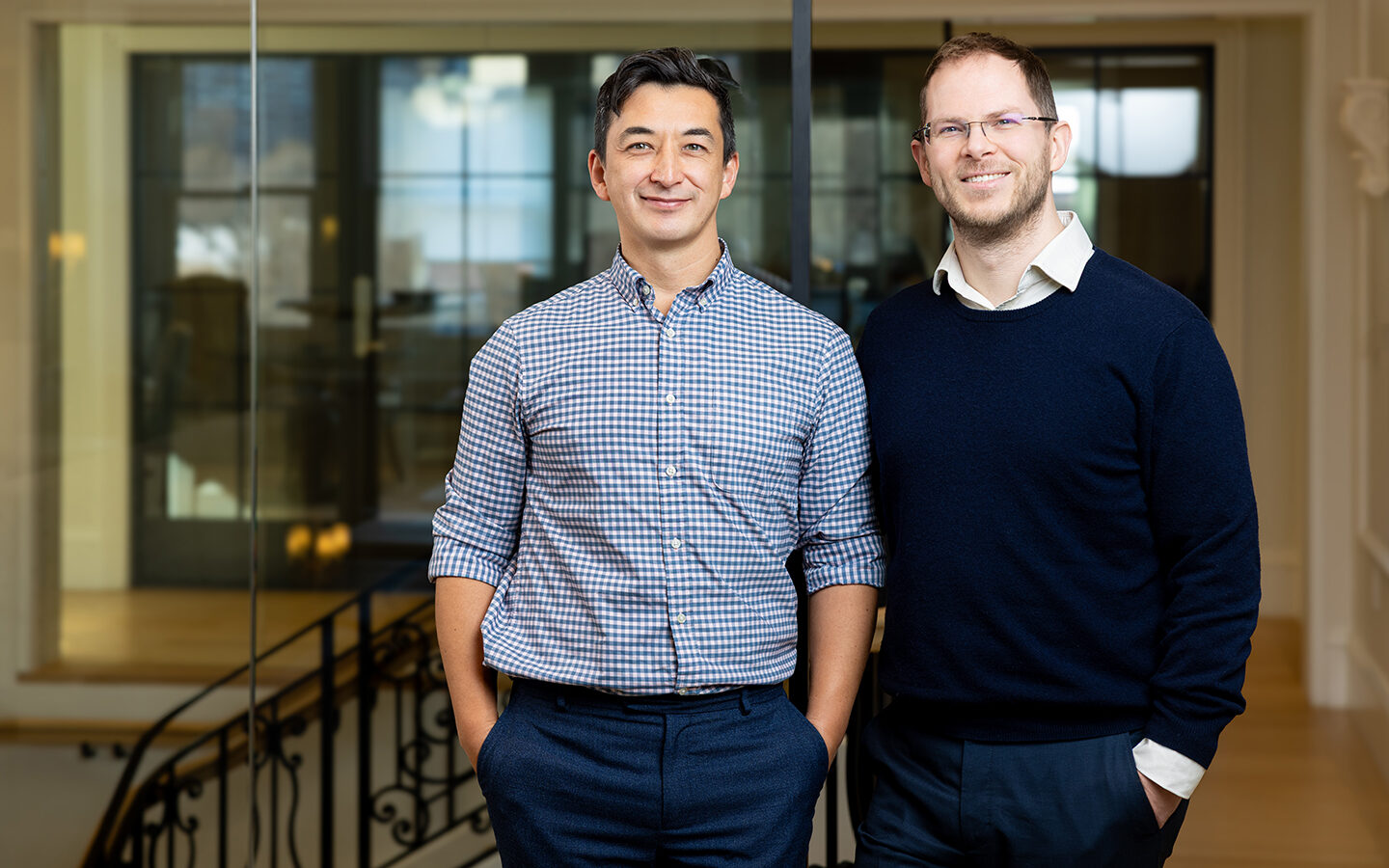
Murat Tunaboylu – Co-Founder & CEO
Ben Holland – Co-Founder & CTO
Partners
Soulmates Ventures
Innovation Investment Capital
DOMiNO Ventures
Development Bank of Wales
Kadmos Capital
i&i Biotech Fund
www.antiverse.io
The Solution
Antiverse is a UK-US techbio company designing next-generation antibody therapeutics for some of the most difficult drug targets in modern medicine – particularly G-protein coupled receptors (GPCRs) as well as other complex membrane proteins. While these receptors are linked to dozens of major diseases, developing large-molecule biologic therapies against them has historically been extremely challenging.
Antiverse combines proprietary generative AI with its own in-house wet-lab infrastructure to solve this problem. Its platform designs highly specific antibodies using advanced machine learning models, then rapidly validates and refines those designs in engineered cell systems developed internally. The experimental results are continuously fed back into the AI models, creating a closed feedback loop that improves accuracy and performance over time.
This integration of computational design and laboratory verification enables Antiverse to move from a target structure to functional antibodies within months rather than years. Instead of relying on random screening approaches, the company engineers antibodies with specific functional properties – such as activating or blocking receptor signaling – expanding their therapeutic potential into areas previously considered inaccessible.
By bringing scalable precision engineering to complex receptor biology, Antiverse is turning one of drug discovery’s hardest challenges into a systematic and repeatable process.
The Challenges
Discovering antibodies against GPCRs and other transmembrane proteins presents two major barriers: first, only a small portion of these receptors is accessible outside the cell membrane, limiting antibody binding surfaces. Second, receptor screening occurs within highly complex cellular environments, where distinguishing true functional binders from background interactions is technically challenging.
Moreover, designing antibodies that not only bind but also modulate receptor function – such as activating or blocking signaling pathways – adds another layer of biological complexity. Traditional discovery approaches rely heavily on random library screening and iterative optimisation, often resulting in long timelines and high failure rates.
Antiverse addresses these challenges by combining structure-guided epitope design, diffusion-based generative models, programmable hyper-expressing cell lines and iterative wet-lab validation. This closed feedback loop reduces biological noise, enhances functional screening and systematically improves model accuracy, transforming one of the most difficult areas of biologics discovery into a data-driven engineering discipline.
The Uniqueness
Antiverse’s unique position draws from the seamless integration of generative AI with proprietary cell engineering and experimental validation. Unlike platforms that rely solely on computational prediction or traditional phage-display screening, Antiverse operates a true “lab-in-the-loop” system: AI models design epitope-specific libraries, engineered cell lines validate functional activity, and the resulting biological data continuously retrains and refines the algorithms.
The company has developed over 200 hyper-expressing stable cell lines capable of significantly increasing receptor surface expression, addressing the “limited surface” and “noisy environment” challenges that have historically hindered antibody discovery against transmembrane proteins. This controlled biological system enhances binder detection, functional characterisation and signal clarity.
In blinded partner studies, Antiverse demonstrated over 94% accuracy in identifying positive binders and generated substantially higher sequence diversity compared to conventional bioinformatics approaches. Its ability to design domain-specific, picomolar-affinity antibodies and functional agonists within months (rather than years) positions the platform at the frontier of AI-enabled antibody engineering.
The Purpose
Antiverse’s purpose is to unlock the largest undrugged class of receptor biology for antibody therapeutics. While GPCRs represent one of the most validated and commercially successful target families in pharmacology, antibody-based modulation of these receptors remains rare. Hundreds of GPCRs are associated with diseases across oncology, metabolic disorders, inflammation and CNS conditions, yet only a handful have been successfully targeted by antibody therapies.
By combining generative AI, structural modeling and proprietary wet-lab systems, Antiverse aims to transform antibody discovery from empirical screening into programmable biological engineering. Its approach enables the rational design of antibodies that can selectively activate or inhibit receptor signaling, offering more precise modulation than traditional small-molecule approaches and expanding treatment possibilities for complex diseases.
Through long-term pharma partnerships and internal pipeline development, Antiverse is building both a scalable discovery engine and a growing proprietary receptor–antibody dataset that strengthens its models over time. The long-term vision is to make biologic GPCR targeting systematic, scalable, and predictable – bringing large-molecule precision to one of medicine’s most challenging target classes.
The Profit
Antiverse operates at the intersection of two rapidly expanding markets: biotech drug discovery and AI/ML technologies. While the global antibody discovery market is projected to surpass $20B by 2034, the most commercially significant targets – GPCRs – remain largely underdeveloped due to their complexity. By transforming empirical screening into a programmable engineering discipline, Antiverse addresses this high-value gap with a definitive operational edge: the platform has reduced development time for de novo therapeutic-grade antibodies to under four months, a process that traditionally takes years.
This efficiency underpins a scalable business model that combines multi-target discovery partnerships, milestone-based licensing, and long-term royalty streams. The company’s technical defensibility is reflected in its $600M potential deal pipeline and a 94% accuracy rate in identifying positive binders during blinded partner studies. Backed by a $9.3 million Series A – bringing total capital raised to over $20M – Antiverse is uniquely positioned to capture market share across both partnered programs and its internal portfolio.
So far, Antiverse has secured partnerships with multiple top-20 global pharmaceutical companies and Nxera Pharma. Furthermore, the company has entered into a research agreement with the Cystic Fibrosis Foundation (CFF). Under the agreement, Antiverse will use its AI-driven modelling and optimisation platform to design antibodies targeting the extracellular region of CFTR. This agreement is designed to support the rapid evaluation of emerging therapeutic modalities and help accelerate progression from early discovery to patients.
With a roadmap to progress its first wholly owned candidates into late-stage preclinical development by 2027, the company is evolving from a strategic techbio partner into a high-growth therapeutics developer targeting several disease-linked GPCRs that currently lack effective treatments.
Sources
-
Biologics Market Size, Share & Trends Analysis Report – Grand View Research, November 2023. https://www.grandviewresearch.com/industry-analysis/biologics-market
-
Biologics Market Size, Share & COVID-19 Impact Analysis – Fortune Business Insights, July 2024. https://www.fortunebusinessinsights.com/industry-reports/biologics-market-100547
-
AI In Drug Discovery Market Size & Share Analysis Report – Grand View Research, January 2024. https://www.grandviewresearch.com/industry-analysis/artificial-intelligence-ai-drug-discovery-market
-
AI in Drug Discovery Market by Offering, Technology & Application – MarketsandMarkets, January 2024. https://www.marketsandmarkets.com/Market-Reports/artificial-intelligence-drug-discovery-market-180834851.html
-
The success of therapeutic antibodies – Nature Reviews Drug Discovery, September 2017. https://www.nature.com/articles/nrd.2017.178
-
Artificial Intelligence (AI) in Drug Discovery Market Analysis – Fortune Business Insights, April 2024. https://www.fortunebusinessinsights.com/artificial-intelligence-ai-in-drug-discovery-market-102244
-
Antibody therapeutics continue to dominate the pipeline – Evaluate Pharma, February 2022. https://www.evaluate.com/thought-leadership/pharma/antibody-therapeutics-continue-dominate-pipeline